Autonomous trucks: what really changes in logistics
By José Ramón Vergara · AI in business and operations
Leer el artículo original en español →
Driverless freight already operates in ports, between warehouses, and on defined highway routes. The operational test is whether the entire delivery network improves, not just the driving leg.
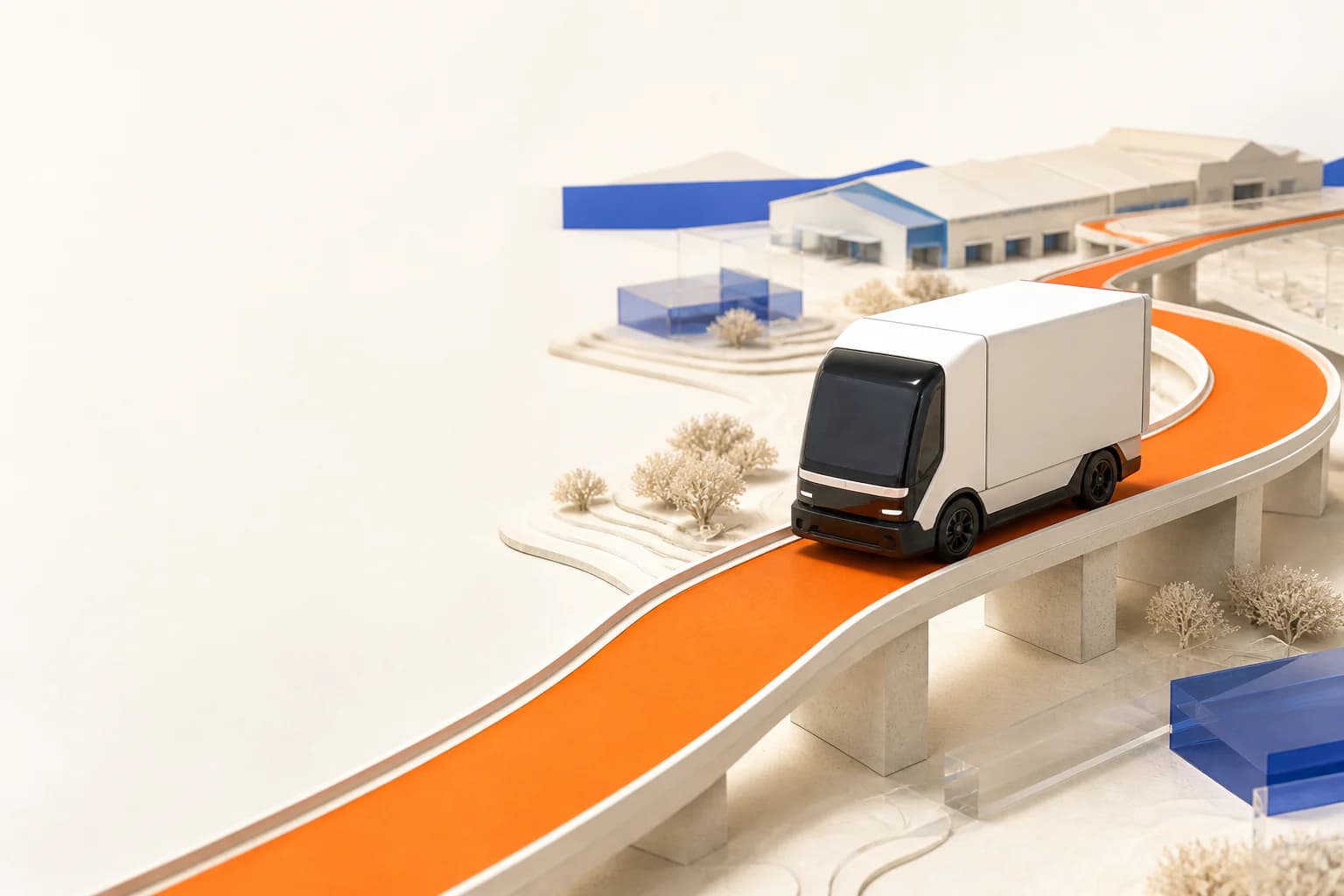
How will autonomous trucks change logistics? First, on repeatable routes with defined operating conditions: inside a terminal, between warehouses, or along a highway corridor. Driving without a person in the cab may change available capacity. It also shifts work to transfers, supervision, maintenance, and the response when a trip cannot proceed as planned. A driverless truck is not an autonomous delivery from end to end.
Real freight, three different operating environments
The following examples show why a port, a short warehouse transfer, and a highway route should not be treated as the same deployment:
- Inside a port. In July 2026, the Port of Felixstowe confirmed an order that would bring its autonomous electric truck fleet to 100 vehicles. The port says the trucks work in mixed terminal traffic, supported by private 5G connectivity and battery swapping. The announcement was an order, not evidence that all 100 trucks were already operating on that date.
- Between warehouses. Einride reported the start of daily commercial driverless freight between Apotea warehouses in Sweden in December 2024. The route has a permit for its section open to a public road, and remote operators can monitor and assist the operation.
- On highway corridors. Aurora said in July 2026 that its commercial network covered 10 driverless routes across the U.S. Sun Belt. Those are defined routes. The release does not establish that any highway route can be run the same way.
These are operator statements, useful evidence that freight is moving. They are not independent proof of cost savings, safety outcomes, or equivalent performance in Latin America.
The work moves beyond the cab
Capacity by corridor. A truck that can run more hours may change how a lane is planned. But utilization must account for loading, unloading, energy or fuel, maintenance, and waiting. Faster line haul can lose its advantage at a dock.
Transfers. Someone still has to hand a load into and out of the autonomous section: receive the vehicle, check the trailer, resolve a delay, and confirm where the freight is. The minutes at each transfer may determine whether the network gains anything from the driverless leg.
Exceptions and safety. The U.S. National Highway Traffic Safety Administration's voluntary guidance uses operational design domain for the roads, geography, speeds, and conditions in which a system is intended to work. It recommends a safe fallback when conditions fall outside that domain. Autonomy therefore needs monitoring, incident procedures, and accountable people around the vehicle.
People and jobs. My expectation is that planning, data analysis, maintenance, and exception handling will matter more. That is an inference about the work, not a promise that no driving jobs will be displaced. The employment outcome depends on which routes expand, which tasks remain human, and how each network is organized.
How I would judge a pilot
I would compare one defined corridor against the current operation for the same freight, schedule, and service level. The scorecard would include end-to-end on-time delivery, waiting at each transfer, vehicle utilization, total cost per trip, human interventions, and safety incidents. I would also document who takes responsibility when the system cannot continue.
If cost per kilometre falls on the autonomous leg while transfers, support trips, or interventions rise, the business case remains unproven. The comparison must cover the full trip. This is the same reason I make assumptions explicit when modelling fleet and hub choices in my Argentina expansion simulator; that case is an example of scenario planning, not evidence that autonomous trucks are ready there.
A scorecard for the entire corridor
This is a proposed evaluation template, not a measured result. Before a pilot starts, I would hold the origin, destination, freight type, service window, and cost-allocation rules constant across the current operation and the pilot. Then I would record:
- End-to-end service: on-time deliveries divided by completed deliveries. Arrival at the destination matters more than when the driverless leg ended.
- Transfers: waiting time at each handoff, including the median and the slowest cases. Record who receives the freight and when the handoff is confirmed.
- Cost per completed delivery: include line haul, loading and unloading, energy, maintenance, remote supervision, support trips, and interventions. Apply the same cost-allocation method to both groups.
- Human work: interventions and supervision minutes per trip, with the reason and the person responsible. A route needing frequent help is less autonomous than its demonstration suggests.
- Safety and limits: incidents, near misses, and trips outside the conditions for which the system was designed. Review every serious event separately; an average does not erase it.
Expansion rule: service and safety must not deteriorate, while total cost improves consistently across representative trips. The number of trips needed depends on baseline variation; I would not prescribe a universal sample size.
What would an Argentina test require?
In Argentina, where we have worked on market entry at 99minutos, I would start with a narrow question: is there a repeatable corridor where transfers can be controlled and the whole delivery can be measured? Then I would examine lane markings, work zones, transfer hub design, connectivity, and energy supply. SAE International identifies these as infrastructure enablers, not as an assessment of any Argentine route. Maintenance, insurance, applicable rules, and incident response also need route-specific answers. None of the overseas examples supplies a deployment date or a countrywide answer for Argentina.
The technology already moves freight. The harder decision is where it improves an entire operation, under which conditions, and with which people around it. Which corridor would you test first?
Frequently asked questions
How will autonomous trucks change the logistics industry?
Defined, repeatable routes are likely to change first. Operators will need to plan capacity by corridor and redesign transfers, monitoring, maintenance and incident response. Savings and service gains depend on the whole delivery network, not only the driverless leg.
Are driverless trucks already carrying commercial freight?
Yes, under different operating conditions. Felixstowe uses autonomous trucks within a port, Einride reported daily warehouse-to-warehouse freight in Sweden, and Aurora reported a commercial network of defined U.S. highway routes. These examples do not prove the same results for every route or country.
Will autonomous trucks replace all drivers?
Current deployments still involve people in monitoring, loading, maintenance, transfers and incident response. The net effect on driving jobs cannot be inferred from a few route announcements; it depends on the scale and design of each network.
Is Argentina ready for autonomous freight?
There is no useful countrywide yes-or-no answer. A potential pilot would need a specific corridor assessment covering road conditions, connectivity, transfers, maintenance, insurance, applicable rules and incident response.
Take the next step.
Radar IA currently publishes in Spanish. The Zoho signup form, confirmation email, and editions are also in Spanish. Subscribe only if you want those articles by email; this does not add you to product offers.
Get Radar IA in Spanish ↗How I handle your information →
Prefer to try an exercise first? The free project worksheet is available in Spanish and requires no email address.