Beyond the click: what changes when AI helps people discover brands
By José Ramón Vergara · AI in business and operations
Leer el artículo original en español →
In BCG's 2026 survey, 91% of B2C CMOs said AI-mediated no-click discovery is reshaping their funnels. What that perception means for SEO and GEO—and what it does not prove.
An AI assistant can answer a question about a brand before someone visits its website. That adds another path to visibility: alongside the click, the information on your site may help support an AI-generated answer. There is no formula that guarantees a citation. The useful question is whether a person can find a clear, original, and defensible answer when they do arrive.
What BCG actually measured
In June 2026, BCG published findings from a survey of 300 CMOs and 50 structured interviews. Four survey findings show the distance between ambition and operation:
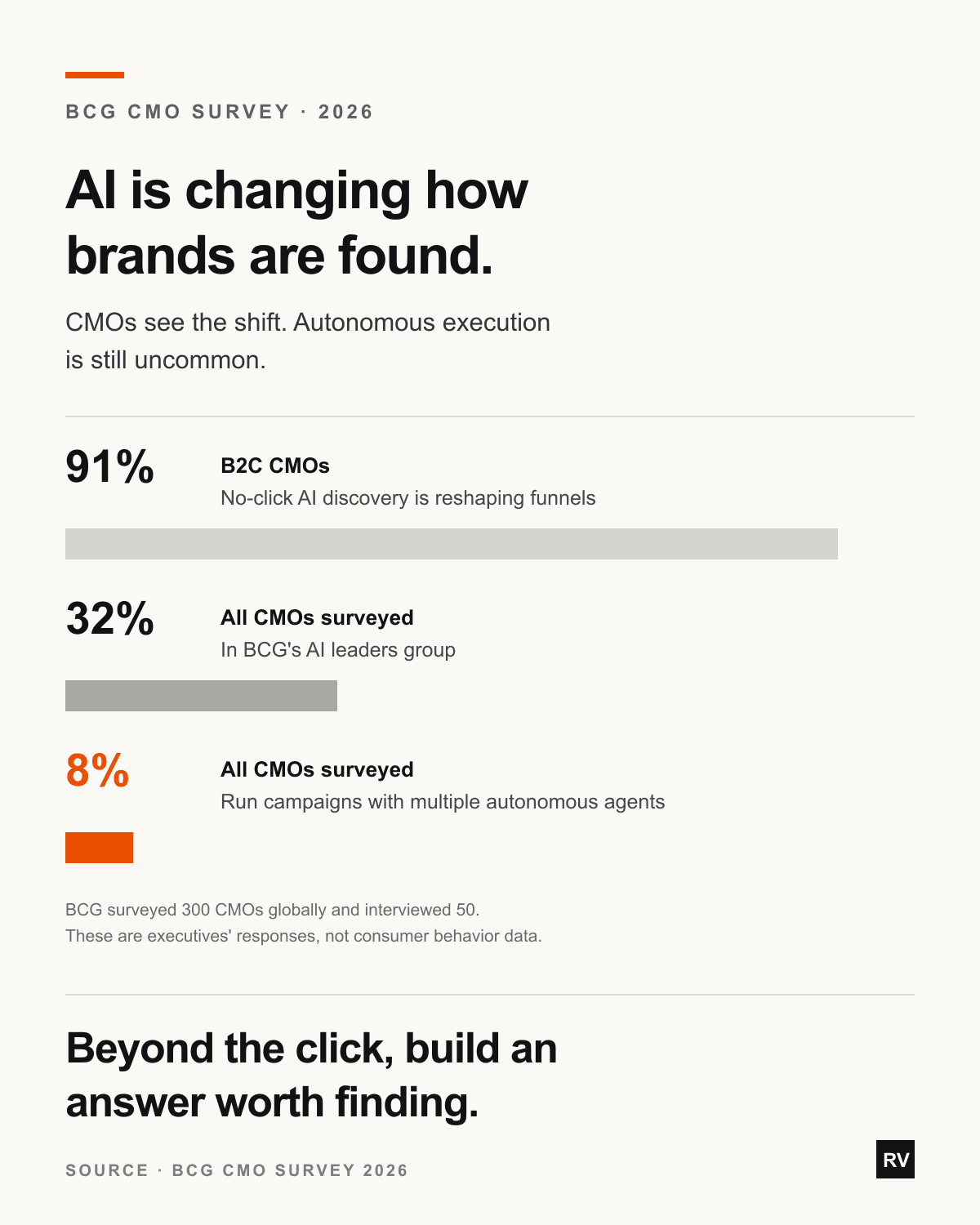
- 91% of B2C CMOs and 76% of B2B CMOs said AI-mediated no-click discovery is already reshaping their funnels.
- 96% reported significant end-to-end AI transformation in their marketing function.
- 42% said they still use generative AI only to assist with discrete tasks.
- 8% ran campaigns in which multiple agents operated autonomously.
Another 90% agreed that generative AI is reshaping how consumers discover and evaluate brands. Those are answers from marketing executives. They do not show that 91% of consumers have stopped clicking, nor that every search begins in an assistant. They show that leaders perceive a change while advanced execution remains uncommon.
My reading: people have more than one route in
Traditional search, links, and a company's own site still matter. AI-generated answers can also show links that support their claims. A person may arrive through either route; the job is to offer something useful when they get there.
Google's guide to generative AI features in Search says familiar SEO foundations still apply: useful original content, pages that can be crawled and indexed, accessible text, and a clear technical structure. Google's AI search features can link to pages used to support an answer. That creates a chance to be found as a source, but adding a FAQ does not make a page certain to be cited.
What I would do before looking for a GEO trick
- Publish knowledge you actually own. A case with decisions, constraints, and outcomes you can explain is more useful than another summary of trends. First-hand experience gives a reader something they cannot get from a generic rewrite.
- Make it accessible. Check that the page is crawlable, indexable, available as text, and linked from relevant pages on your site. Technical access is the starting condition for search visibility.
- Attribute the numbers. When using someone else's statistic, name who measured it, the sample, and when. Attribution lets the reader test the argument; it does not buy an AI citation.
- Organize for the reader. Begin with an answer that helps, then use sections or questions when they clarify the reasoning. There is no ideal article length or required “AI-friendly” chunk size.
Google also says it does not use llms.txt or require special markup for its generative search features. Such files may be useful to other systems that choose to read them, but they do not replace content quality, indexing, or a good visit to the site.
How I apply this here
I want readers to understand what I have built across AI, data, and growth in Latin America, and to check the outside numbers I cite. The SEM/SEO acquisition dashboard case describes how I connected lead data with CRM stages while keeping personal information out of the public view. It is an example of original work that a visitor can examine; it is not evidence that an AI system will cite this website.
Likewise, my AI adoption guide starts from a decision, data source, owner, and routine instead of promising an AI shortcut. I separate published findings from my operational interpretation, link to original sources, and explain where a case ends and an inference begins. The content should be worth reading whether a visit starts in a search result or an AI answer.
The question for a company is no longer only “Where do we rank?” It is also: If someone asks about our category, does our site offer a distinctive, clear, and defensible answer?
Sources
- BCG, Making the Agentic Marketing Transformation a Reality (2026 global CMO survey, 300 respondents and 50 interviews).
- Google Search Central, Google's guide to optimizing for generative AI features on Google Search.
Frequently asked questions
What is AI-mediated no-click discovery?
It is an experience in which a person gets an answer or recommendation from AI before visiting a website. In BCG's 2026 survey, 91% of B2C CMOs and 76% of B2B CMOs said it was reshaping their funnels. Those are executives' perceptions, not a direct measure of all consumers.
How is GEO different from SEO?
GEO describes work aimed at visibility in generative answers. For Google's AI search features, its own guidance says established SEO fundamentals still apply; there is no special file, markup, or content format required to appear.
Can any page structure guarantee an AI citation?
No. Original, useful content that can be crawled and indexed, clear text, and verifiable attribution can help readers and search systems understand a page. Headings and FAQs can improve readability, but they cannot guarantee a citation.
Take the next step.
Radar IA currently publishes in Spanish. The Zoho signup form, confirmation email, and editions are also in Spanish. Subscribe only if you want those articles by email; this does not add you to product offers.
Get Radar IA in Spanish ↗How I handle your information →
Prefer to try an exercise first? The free project worksheet is available in Spanish and requires no email address.